Build a Career in Court Reporting
Learn machine stenography with expert instruction, structured practice, and personalized support from an experienced court reporter.
Don't wait to apply! Deadline for Fall 2026 is September 10
〰️
Don't wait to apply! Deadline for Fall 2026 is September 10 〰️
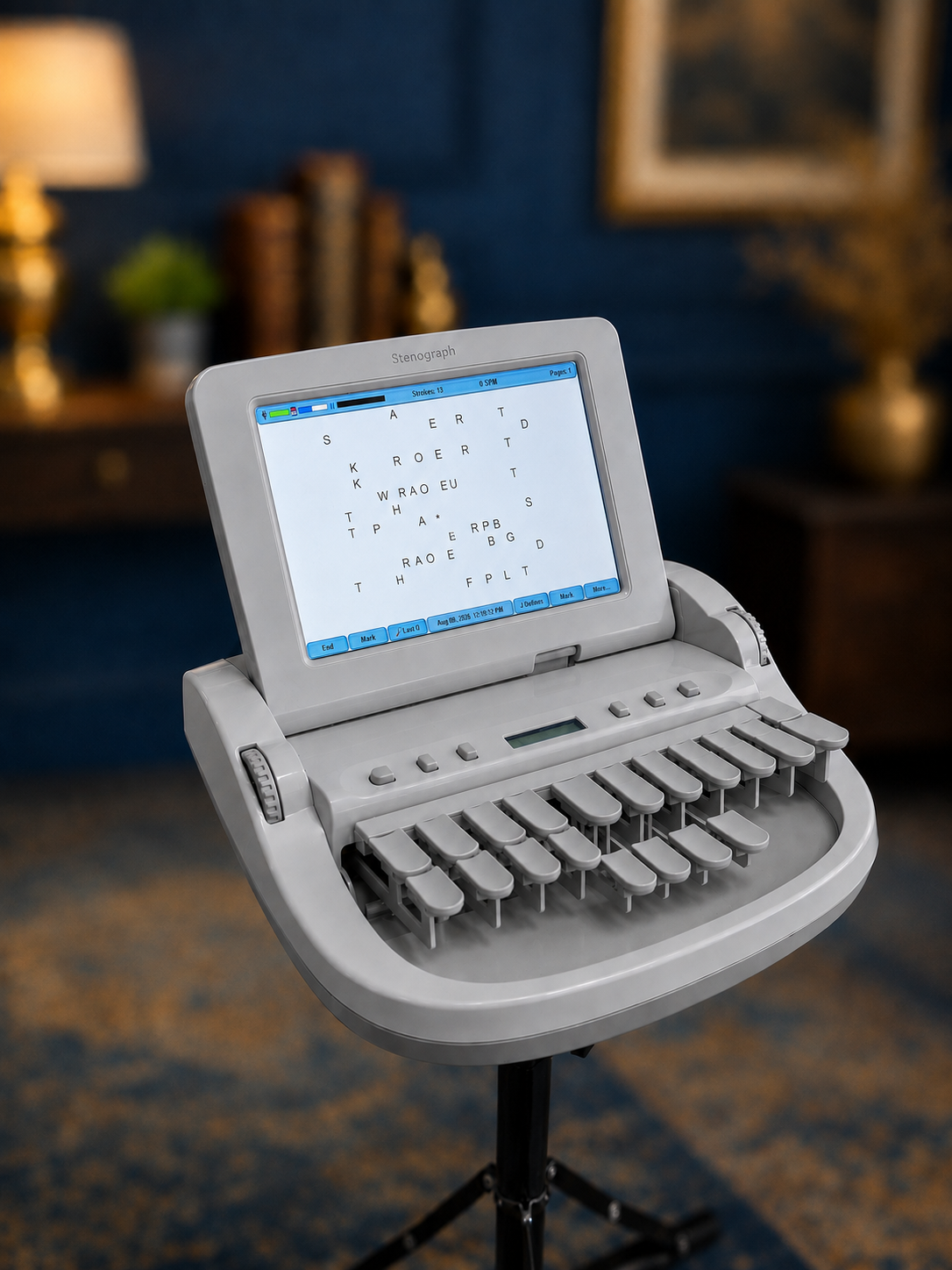
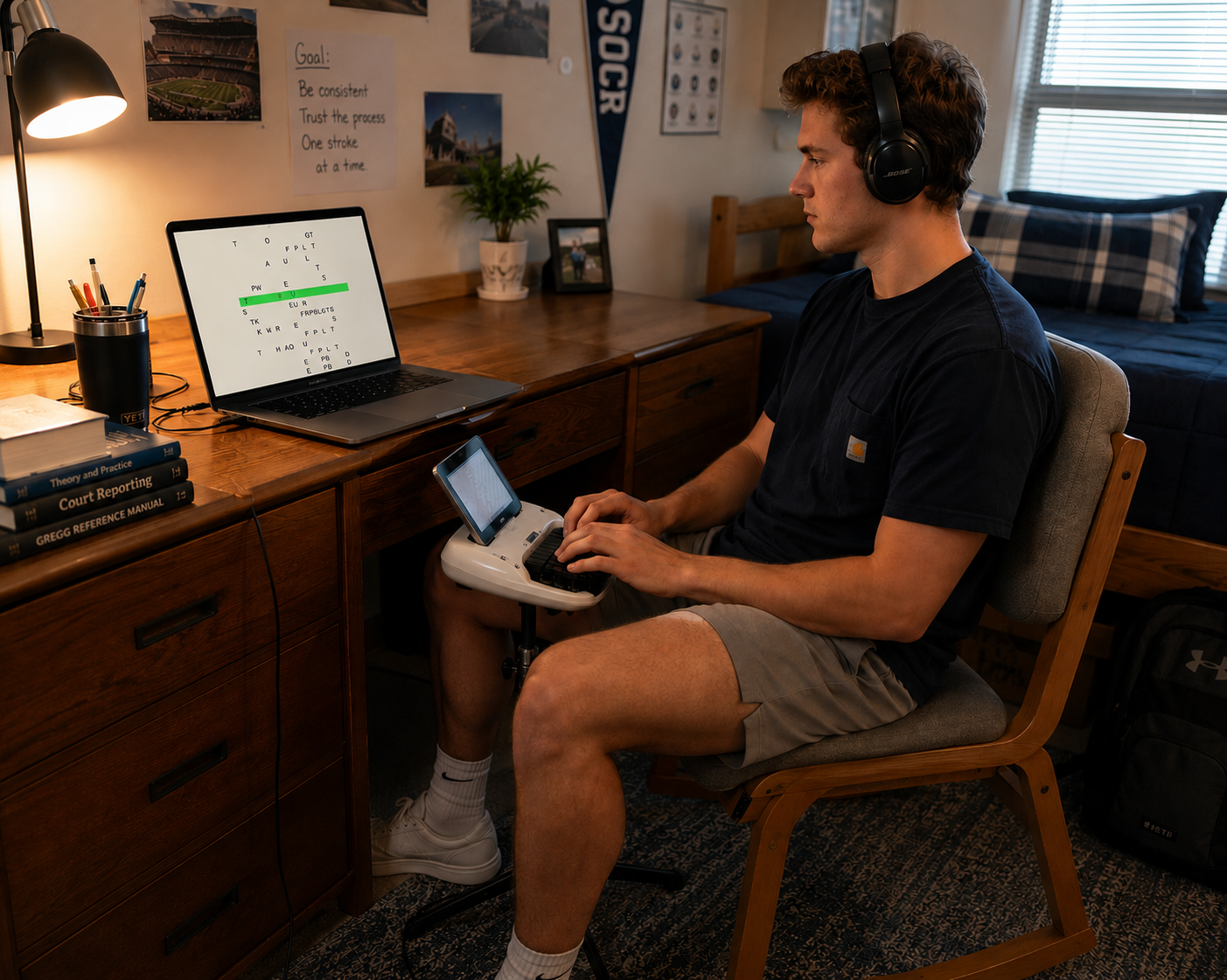
The message written on the machine in steno says: "A certified court reporter can write this faster than you can read this."
Practical Training for a Specialized Profession
Our online Machine Steno Program prepares students for rewarding careers as professional court reporters, CART providers, and broadcast captioners through comprehensive training in machine shorthand, court reporting-related punctuation, legal and medical terminology, CAT software, transcript production, professional procedures, ethics, and certification preparation.
Students develop the skills to produce accurate real-time records at speeds up to and above 225 words per minute while preparing for careers that offer exceptional income potential, flexible work opportunities, and nationwide demand. Whether you're beginning a new career or seeking long-term stability and purpose, SCR provides the personalized instruction, practical training, and ongoing support to help you achieve your goals.
Diverse Career Opportunties

Court

Educational Institutions

Law firms

live broadcast

closed captioning
Ready to get started?
Ready to get started?
Schedule a 30-minute introductory call to learn more about the program, ask questions, and make sure it’s a good fit before enrolling.
Course Descriptions
StenEd Realtime Theory (SCR-Modified)
The School of Court Reporting teaches the StenEd Realtime Theory, enhanced with exclusive SCR-developed modifications and supplemental steno phrases and briefs. These additions simplify writing, improve word-building skills, and promote greater writing efficiency while maintaining the proven, conflict-free foundation of the StenEd system.
Required Textbook: StenEd Realtime Theory, 10th Edition (2023), Beverly Loeblein Ritter. Available here
Theory Courses
Class Sessions & Practice Labs
Theory students participate in:
Five (5) hours of live instructor-led classroom instruction each week.
Ten (10) hours of weekly guided practice, including read-back exercises.
Unlimited access to My Realtime Coach® (RTC) online practice labs, available 24/7.
A My Realtime Coach® subscription is included with tuition.
Theory I
StenEd Lessons 1–22. Students learn the foundational principles of machine stenography while developing beginning-level writing skills through SCR supplemental phrases and briefs.
Theory II
StenEd Lessons 23–40. Students complete the StenEd theory curriculum while expanding their writing skills with intermediate-level SCR supplemental phrases and briefs.
Speed-Building Courses
Speed-building courses utilize instructor-guided dictation, testing, and My Realtime Coach® (RTC). Students are tested in Question & Answer (Q&A), Jury Charge, and Literary material. A minimum score of 95% accuracy is required before advancing.
Speed-Building I
40–100 WPM
Speed-Building II
120–160 WPM
Speed-Building III
180–225 WPM
*Speed-building achievement varies by student and advancement is based upon individual proficiency.
Academic Courses
Beginning Vocabulary for Court Reporters
Introduces parts of speech, verb tenses, beginning legal vocabulary, and homonyms (A–D). Weekly assignments.
Intermediate Vocabulary for Court Reporters
Continues vocabulary development with advanced terminology and homonyms (E–Z). Weekly assignments.
CAT Software Fundamentals
Introduces software installation, realtime connections, dictionary management, and basic software navigation. Students should obtain CAT software by October 15.
CATalyst Software Training
Comprehensive instruction in editing, dictionary maintenance, transcript production, and realtime features.
Required textbook: Learn to Use CATalyst, 14th Edition (2023) by Kathryn Dittmeier, CRI. Available here
Recommended during Theory II.
My Realtime Coach®
Included with tuition. Provides guided practice, StenEd lessons, testing, speed-building, and progress tracking.
Legal Terminology for Court Reporters
Develops legal terminology used in courts and depositions. No textbook required. Weekly assignments and quizzes.
Punctuation for Court Reporters I
Chapters 1–15. Weekly assignments and quizzes.
Punctuation for Court Reporters II
Chapters 16–31. Weekly assignments and quizzes.
Required Textbook for Punctuation I & II: Court Reporting: Bad Grammar/Good Punctuation by Margie Wakeman Wells. Available Here
Beginning Transcript Production
Production of Question & Answer, Jury Charge, and Literary transcripts through weekly assignments.
Medical Terminology for Court Reporters
Weekly assignments and final exam.
Required textbook: Medical Terminology, 9th Edition, Davi-Ellen Chabner. ISBN 978-0-323-47991-2.
Court Reporting Procedures & Professional Ethics
Recommended after achieving 120 WPM. Covers courtroom and deposition procedures, administering oaths, exhibit handling, speaker identification, transcript formatting, ethics, confidentiality, and professional conduct.
Advanced Transcript Production
Advanced transcript preparation including title, appearance, index, certificate pages, PDF creation, and final transcript production.
Certified Shorthand Reporter (CSR) Written Knowledge Test Preparation
Recommended after achieving 160 WPM. Comprehensive preparation for the Certified Shorthand Reporter (CSR) Written Knowledge Test.
Court Reporting Internship
Recommended after achieving 160 WPM. Students observe 12 hours of court proceedings, 12 hours of deposition proceedings, produce one court transcript (minimum 10 pages) and one deposition transcript (minimum 10 pages), and maintain signed observation logs.
This course is graded on a pass/fail basis. Students must complete all required hours and assignments satisfactorily to fulfill program requirements and be awarded a Certificate of Completion.
Already enrolled in another program? We welcome transfer students who wish to join our online speed-building and academic courses.
Academic
Calendar
The School of Court Reporting operates on a three-semester academic calendar consisting of Fall, Spring, and Summer sessions. Specific dates are subject to change and will be announced prior to each academic year.
Fall 2026 |
First Day of Classes |
Tuesday, September 14 |
|---|---|---|
Thanksgiving Holiday (No Classes) |
Thursday, November 26 |
|
Last Day of Classes & Final Examination |
Thursday, December 17 |
|
Spring 2027 |
First Day of Classes |
Monday, January 11 |
Spring Break (No Classes) |
March 15–29 |
|
Last Day of Classes & Final Examination |
Thursday, May 6 |
|
Summer 2027 |
First Day of Classes |
Monday, May 24 |
Last Day of Classes |
Thursday, August 12 |
Curriculum
Fall 2026 (14 weeks)
1st Session
Theory I - StenEd Lessons 1-22 with beginner-level supplemental steno phrases and briefs
Beginning Dictation & Read-Back
CAT Software Fundamentals
Beginning Vocabulary for Court Reporters
My Realtime Coach™ Online Practice Videos
Spring 2027 (16 weeks)
2nd Session
Theory II - StenEd Lessons 23-40 with intermediate-level supplemental steno phrases and briefs
Advanced Beginning Dictation & Read-Back
CATalyst Software Training – “Learn to Use CATalyst”
Intermediate Vocabulary for Court Reporters
My Realtime Coach™ Online Practice Videos
Summer 2027 (12 weeks)
3rd Session
Speed-building I (40-100 WPM*)
Intermediate Dictation & Read-Back
Legal Terminology for Court Reporters
Fall 2027 (14 weeks)
4th Session
Speed-Building II (40 – 160 WPM*)
Intermediate Dictation & Read-Back
Beginning Transcript Production
Medical Terminology for Court Reporters
Punctuation for Court Reporters I
Spring 2028 (16 weeks)
5th Session
Speed-Building III (40–225 WPM*)
Proficient Dictation & Read-Back
Intermediate Transcript Production
Punctuation for Court Reporters II
Court Reporting Procedures & Professional Ethics†
CSR Written Knowledge Test (WKT) Preparation & Testing†
Summer 2028 (12 weeks)
6th Session
Advanced Speed-building (200 – 225 WPM*)
Advanced Dictation & Read-Back
Advanced Transcript Production
CSR Certification Preparation
Court Reporting Internship
* Speed-building progress varies by student and may extend beyond the scheduled session.
† Students typically complete these courses after achieving approximately 160 WPM writing speed.

Meet Your Instructor
Judy Evans, CSR, RPR, CRI
Judy Evans began her court reporting career in the early 1990s after earning her degree in Court Reporting from Concordia University Wisconsin. After relocating to Texas and taking time away from the profession to raise her family, she remained connected to the industry by operating a successful transcription business for 15 years using her machine stenography skills.
Since returning to court reporting in 2012, Judy has worked as both a freelance and official court reporter and has served as an official court reporter since 2017. In 2020, she began teaching court reporting at a local community college, instructing students in both the Magnum Steno Theory and the StenEd Realtime Theory.
Today, as founder and instructor of the School of Court Reporting, Judy is dedicated to helping students achieve success in this rewarding profession through personalized instruction, encouragement, and a genuine passion for teaching.
Program Tuition & Fees
Theory Steno Program
$2,200/year (save $200) or $300/month
30 weeks / 60 live classes
Cost includes a monthly subscription to My Realtime Coach ($76 per month)
Program Dates: September 14, 2026 – May 6, 2027
Theory Program Down Payment $224
The down payment secures your place in the program and is applied towards tuition.
Continuing Education
For students who have completed theory at another program, we offer flexible class options.
Speed-Building Program $225/month
Academic Classes $75/month per class
Ready to get started?
Schedule a 30-minute introductory call to learn more about the program, ask questions, and make sure it’s a good fit before enrolling.
Frequently Asked Questions
-
The School of Court Reporting teaches the StenEd Realtime Theory, enhanced with exclusive SCR-developed modifications and supplemental steno phrases and briefs.
-
Students complete the program in approximately 24 to 36 months, but this depends on each student’s individual ability to grasp the theory and move up in speed. The theory course takes eight months, and it is possible to complete speed-building in 12 to 18 months.
SCR does not guarantee that students will complete the Machine Steno Program within the estimated time frame. Every student progresses at a different pace based on individual abilities, study habits, practice time, and personal responsibilities. Because machine stenography is a highly specialized skill, the time required to develop speed and proficiency varies from student to student. Some students may complete the program sooner than expected, while others may require additional time. Students who do not complete the program within the estimated time frame may continue their training by paying tuition on a prorated monthly basis until program completion.
-
Theory and Speed-building classes are hybrid classes. There are two live evening classes per week Monday and Thursday evenings from 6 to 8:30 pm CST via Zoom, for a total of five hours of live instruction per week. Students are expected to practice and study on their own the rest of the week for another 10 hours.
Elective classes are asynchronous. Books for each class will need to be purchased, and homework and tests are online. -
The average salary of an official court reporter in Texas is between $85,000 and $140,000 annually, plus transcripts and health and retirement benefits. Freelance court reporters’ income depends on the amount of work they perform. Income can range between $60,000 and $75,000.
-
No, we do not.
-
Prospective students are high school graduates or above and have completed one of the free introductory courses, either Project Steno or A to Z.
Successful court reporting students come from many different backgrounds, but they often share several important qualities: a strong command of the English language, a commitment to meeting deadlines, confidence using technology, strong organizational skills, self-motivation, and a willingness to practice consistently and hold themselves accountable. With dedication and perseverance, these qualities can help you build the skills needed for a rewarding career in court reporting. -
The following are recommended steno machines that may be purchased or rented:
Luminex CSE
Elan Cybra
Elan Mira
Wave
Students who wish to use an alternative steno machine model should contact the school for approval prior to enrollment.
Steno machines may be purchased at discounted prices through the following vendors:
-
Students must use the student version of Stenograph’s CaseCATalyst, a computer-aided transcription (CAT) software program. This software translates the language of your steno theory into English text. The monthly fee is $17 per month (Link).
Please see Stenograph’s System Requirements for Case CATalyst. Case requires a PC-based system running Windows 10, or higher. CATalyst cannot be used on a Mac computers. (Link)
Students may lease or purchase CaseCATalyst directly from Stenograph Corporation at this link or by calling 800-323-4247.
-
No, it is not.
A college degree is not required to become a certified court reporter in Texas. To qualify for certification, students must successfully pass the Texas Certified Shorthand Reporter (CSR) Skills Examination and Written Knowledge Test (WKT). Upon earning certification, graduates are legally qualified to work as court reporters throughout the state of Texas.
Helpful Resources




Court Reporting News